Black icons in data
The theme for Black History Month 2026 is Honouring our Communities. So let’s honour some incredible Black icons in the data community, both past and present. Our list of icons are all outstanding data professionals AND remarkable role models, including Edafe Onerhime, Fash Fasoro, Anne-Marie Imafidon, Nira Chamberlain, Maggie Aderin, Donald Palmer, W.E.B Du Bois and Gladys West.
Edafe Onerhime

Edafe is a data leader, author, and key-note speaker. She’s an expert in responsible AI, data science, analytics, data strategy and data architecture. Her career spans over 25 years across financial services, the public sector and consultancy.
In 2023, Edafe delivered our most popular talk ever: ‘White and other defaults, understanding assumptions – how they affect our data and our world’. Some key reminders are:
Data is not neutral
Think about what biases are baked into your data
It is not your fault that you have biases, but it is your responsibility to think about what assumptions you are making
Edafe advocates for technology, especially data-driven technologies to be a driver for equity and equality. She ascribes to the philosophy that tech must support, not replace, human ingenuity.
Outside of her day job: She’s an executive coach and mentor, a steward at Data, Tech and Black Communities, an adviser to the World Economic Forum, a community volunteer at Open Data Camp, and a former volunteer on Data Orchard’s board of directors.
Fash Fasoro

Fash is a serial social entrepreneur, passionate about empowering underrepresented communities in data and AI. He’s CEO of The DataKirk, an Edinburgh-based social enterprise, focused on building digital economy skills in data literacy and analytics to close the data divide and attainment gap in Scotland.
Fash focuses on fostering connections between diverse communities, organisations, and individuals. “By creating opportunities for collaboration and dialogue, we aim to bridge gaps, promote inclusivity, and build a stronger, more connected society.”
Through strategic training, mentorship, and work placements, his leadership is supporting hundreds of young and marginalised people to excel in their careers and contribute meaningfully to the world of work.
In October, The DataKirk run an amazing 5-day talent summit celebrating diversity, innovation and impact. You can find out about the Scottish Ethnic Minority Talent Summit here.
Dr Anne-Marie Imafidon MBE

Anne-Marie is a former child prodigy, now author, speaker and social enterprise founder. She passed her computing A-Level at age 11 and was one of the youngest to ever receive a Master’s Degree in Mathematics and Computer Science from the University of Oxford. Since then, she has held positions at Goldman Sachs, Hewlett-Packard and Deutsche Bank, and been awarded honorary doctorates from numerous universities across the UK and an Honorary Fellowship at Keble College, Oxford.
In 2025 she was appointed as the Department for Science, Innovation and Technology’s Women in Tech Envoy, co-chairing a Taskforce with the Secretary of State. In 2026 she was awarded an Honorary Professorship by Glasgow Caledonian University, where she also serves as Chancellor. She regularly speaks on topics like the future of work, diversity, equity and inclusion, and artificial intelligence.
She co-founded Stemettes in 2013 with a vision to inspire and support girls, young women, and non-binary young people into Science, Technology, Engineering, Arts, and Maths (STEAM) careers. The organisation runs a huge range of events, and training, mentoring and networking programmes for young people. This work led to her being awarded an MBE in 2017.
Take a look at Anne-Marie's website here
Nira Chamberlain OBE

Nira is a mathematical modeller and a chartered scientist, specialising in modelling and simulation algorithms. With armloads of accolades and titles he’s an eminent and influential leader in mathematics. In 2018, he won the title ‘World’s Most Interesting Mathematician’. He also has a PhD, an OBE, and was named in the PowerList as one of the top 100 most influential Black people in the UK for five years running (2018-2022).
Whilst he’s developed solutions to complex problems in industries such as defence, aerospace and energy, his charity work has been equally inspiring. As a speaker with the charity Speakers for Schools he does brilliant work with children and young people. Here’s what he did with school children in Birmingham:
“I did an entire workshop called ‘Saving Aston Villa’ and they developed their own mathematical model to save their football team. They’re seeing ‘wait a minute, this is mathematics in action, this is real-world mathematics’.”
It must have worked, because Aston Villa went on a winning streak and qualified in the UEFA Champions League for the first time in 40 years!
Dame Maggie Aderin

Maggie is a space scientist and science communicator. Maggie has worked on many projects throughout her career. These include project managing the development of hand-held instruments to detect landmines, developing a high-resolution spectrograph for the Gemini telescope and being the lead scientist at Astrium – managing observation instruments on a satellite which measured wind speeds to help investigate climate change.
Maggie has written numerous books, presents the BBC’s The Sky at Night, and engages with many children and adults to inspire new generations of astronauts, engineers and scientists. Her talks lead her to myth-bust about careers, class and gender, whilst explaining how and why she became a scientist. She speaks inspirationally on how dyslexia affected her school life and is an ambassador for the charity Made by Dyslexia.
In 2009, she received an MBE for services to science and science education. In 2024 she was appointed a Dame Commander of the British Empire in the New Year Honours. She’s also a Commissioner for the Commission on Race and Ethnic Disparities.
Watch Maggie talk about Reaching for the Stars – The power of crazy dreams
Dr Donald Palmer

Donald is an Associate Professor of Immunology, who carried out post-doctoral work at Cancer Research UK and Imperial College, London. His research involves the identification of cell ‘markers’, which can help us learn about how the body protects itself from diseases such as cancer and infections. He is especially interested in the way the immune system changes with age and is a member of the British Society for Research on Ageing.
Donald is a co-founder of the social enterprise Reach Society, which aims to encourage and inspire Black boys and young Black men to realise their potential through mentorship, careers and networking programmes. In July this year, he was presented with a Special Award at the Black and Minority Ethnic (BME) Early Career Researcher (ECR) Legacy Awards at King's College London, in recognition of his continued commitment to advancing equity, diversity and inclusion.
W.E.B Du Bois

1868-1963
Whilst all the above icons are alive today, we can’t write a piece like this without mentioning W.E.B Du Bois, the father of data visualisation. An American sociologist, historian, author and activist, he was perhaps the most important Black protest leader of the early 20th Century. He received his Ph.D from Harvard University in 1895.
Du Bois conducted extensive research into the experiences of Black communities in America. His book W.E.B Du Bois’s Data Portraits – Visualising Black America delivered a powerful representation of African American people, inequality, racism, the effects of slavery, and advances in education.
His groundbreaking charts, graphs and maps were exhibited at the 1900 Paris Exposition – a world fair celebrating the achievements of the past century to accelerate development into the next.

W.E.B Du Bois, 1900 from The Exhibit of American Negroes, Paris. Source: Library of Congress
Gladys West
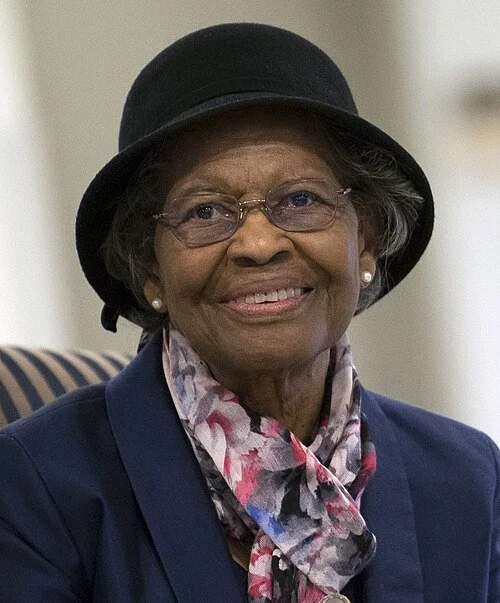
1930-2026
This is also a chance to honour a groundbreaker that passed away this year, and who was only recognised for her work later in life.
Where would we be today without GPS?
Gladys West rose from a poor upbringing in still-segregated rural Virginia, USA, to become one of four African-Americans working at the navy’s weapons facility in Dahlgren, Virginia, in 1956.
As a computer programmer, her work was key, first to studying and measuring movements of other planets, then to precisely measuring the surface of the Earth.
In 1986, her 51-page paper Data Processing System Specifications for the Geosat Satellite Radar Altimeter, provided the calculations that were used as the basis of GPS. This work directly contributed to the accuracy we see in today’s GPS systems, which are able to take into account the uneven and undulating shape of the Earth.
Because the work Gladys did was top secret, her input only came into public knowledge long after her retirement. In 2018 she was enshrined in the US Air Force Space and Missiles Pioneers Hall of Fame, in a ceremony at the Pentagon.
Her biography, It Began With a Dream, was published in 2020. Summing her up, in an interview with Virginia Public Media, she explained her goals: “Do your best work, work hard ... and be a real good person.”